Erythrae
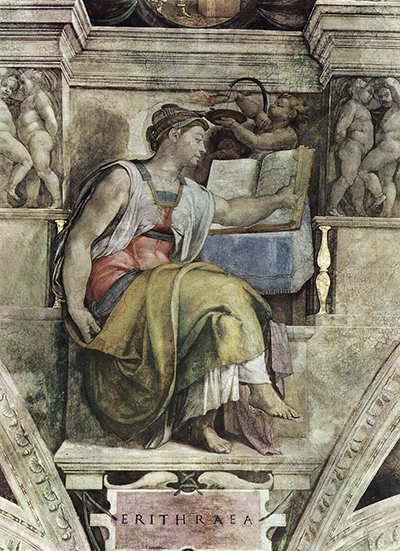
What the Greeks knew.
The Erythraean Sibyl lived on the coast of Ionia, in what is now Turkey. Where other oracles spoke in trance or read natural signs, Erythrae was a writer. Her prophecies were long, formal poems — and they were famous for their architecture.
She wrote in acrostics. The first letter of each line, read straight down the page, spelled out a second message hidden inside the first. The surface text said one thing. The structural read revealed another. Reading her required reading twice: once horizontally for content, once vertically for meaning. Two layers in the same body of text. Both true. Both the prophecy.
The surface said one thing. The structure said another. Some truths only appear when you read sideways.
Her acrostics were so revered that her texts were collected and consulted by the Romans during national emergencies. They were treated as serious enough that the entire form survived — Greek and Roman writers continued to compose acrostic prophecies in her style for centuries.
But the part of her legacy that puts her on this panel happened much later, and it is unique among the oracles. Early Christian writers, reading her surviving prophecies, found one acrostic whose hidden vertical message read, in Greek, as a Christological statement. They took it as evidence that even pagan oracles had prefigured Christ. Whether the text was authentic or a later interpolation is disputed, but the belief in it made the Erythraean Sibyl sacred to a tradition that had nothing to do with Apollo.
Centuries later, Michelangelo painted her on the ceiling of the Sistine Chapel. She sits there to this day, alongside Isaiah and Jeremiah and Ezekiel, as a pagan witness to a truth she could not have known she was foretelling. No other ancient oracle made the journey from temple to Vatican. She made it because of her method — because the truth she carried was hidden in structure, and a different tradition read her structure and found something they recognized.
Replicating Erythrae.
Our Erythrae is the structural critic on the panel. Where the other oracles read what your article says, Erythrae reads how your article is built.
The implementation uses a language model with a system prompt that explicitly redirects attention from content to architecture. Erythrae is not asked whether the claims are accurate or the writing is fluent. Erythrae is asked: what does the shape of this article reveal? Where in the document does the strongest argument actually sit, and what does its placement say about what the author thought was important? Which sections were given weight by length and position, and which were buried? What does the structure admit that the surface does not?
These are the questions an editor asks. They are also the questions a serious reader asks unconsciously, even when they don't notice they're asking them. Articles that don't survive a structural read are articles that hide their weaknesses in good prose. Erythrae is the oracle that reads the prose and the bones simultaneously, and reports on the bones.
This is the oracle most aligned with what content quality auditing is fundamentally about. The other oracles add depth in their own ways. Erythrae is the one that does the work of asking why this article is shaped the way it is, and whether that shape serves the reader. When she reports that an article's most important claim is buried beneath supporting material, that is the acrostic read. When she reports that the citations cluster in the easy paragraphs and disappear from the harder ones, that is the structural prophecy.
Michelangelo painted Erythrae because her method outlived her. The truth she found in structure was strong enough to mean something to a different tradition centuries later. We use her name on the panel for the same reason. Reading structure is older than the printed page, older than the modern editor's craft, older than anything we would call SEO. It is the oldest form of careful reading we have.
When you see Erythrae's verdict on your audit, you are seeing what the architecture of your article reveals about itself. Not the content. The acrostic.